Cellpose-SAM
Cellpose with the Segment Anything image encoder, trained to generalize across cell images.
Pachitariu, Rariden and Stringer · Janelia Research Campus · 2025
CellWorkflow turns microscopy, from a single 3D stack to a terabyte time-lapse, into a working model of the experiment: which cells are there, what they look like, who they touch, how they change, and under which treatment. Dig into that model yourself, or let Claude, ChatGPT or your own agent run the analysis, with the numbers behind every answer.
Phenomics is the measurement of everything a cell shows: its shape, its state, its behavior. Most of it today happens on flat images of cells in plates, thousands of wells at a time, and it works well for what it is. But a flat image leaves out the tissue around a cell, and a single snapshot cannot tell you where it was going or what happened to it next.
CellWorkflow does phenomics on the experiments you actually run: an organoid or a tissue imaged in 3D, or a live co-culture followed for hours or days. A cell's phenotype includes its shape, its neighbors and its contacts, and over time its trajectory and how it responded. From a single stack to terabytes of them, with the same rigor you would expect from a screen.
A microscopy volume holds all of the biology and none of the bookkeeping. Which blob is which cell, whether it is the same cell as in the last frame, whether it touched the organoid, which well it came from: none of that is written down anywhere. CellWorkflow writes it down. Segmentation, tracking, measurement and analysis turn the volume into a record of the experiment that can be queried, compared and audited, by you or by an agent.
Intensity values, arranged in space and time. Anything a biologist wants to know about them has to be worked out first, and it usually gets worked out once, by hand, in a spreadsheet nobody can find a year later.
Nothing gets exported to a spreadsheet halfway through. A figure at the end still knows which statistic it shows, which cells went into it, and which frames those cells came from.
Upload the file your microscope wrote, whether that is a 2 GB .nd2 or a 2 TB .czi. We convert it once and stream it to the browser.
Cells and structures are found in 3D and followed through division, death and crowding. Use the current open models as they are, or fine-tune one on a few of your own annotations.
Shape, intensity, speed, neighbors, contacts and how long they lasted, for every cell in every frame. Cells that behave alike are grouped into phenotypes.
All of it lands in one place, together with the conditions, replicates and fields of view of the experiment, and the version of each step that produced it.
Ask questions in the Atlas, or let an agent call the same operations: compare conditions, split by phenotype, follow the effect over time, check confounders, pull up examples.
Effect sizes with confidence intervals and sample sizes, plots, representative cells and tracks, and a link back to the frames.
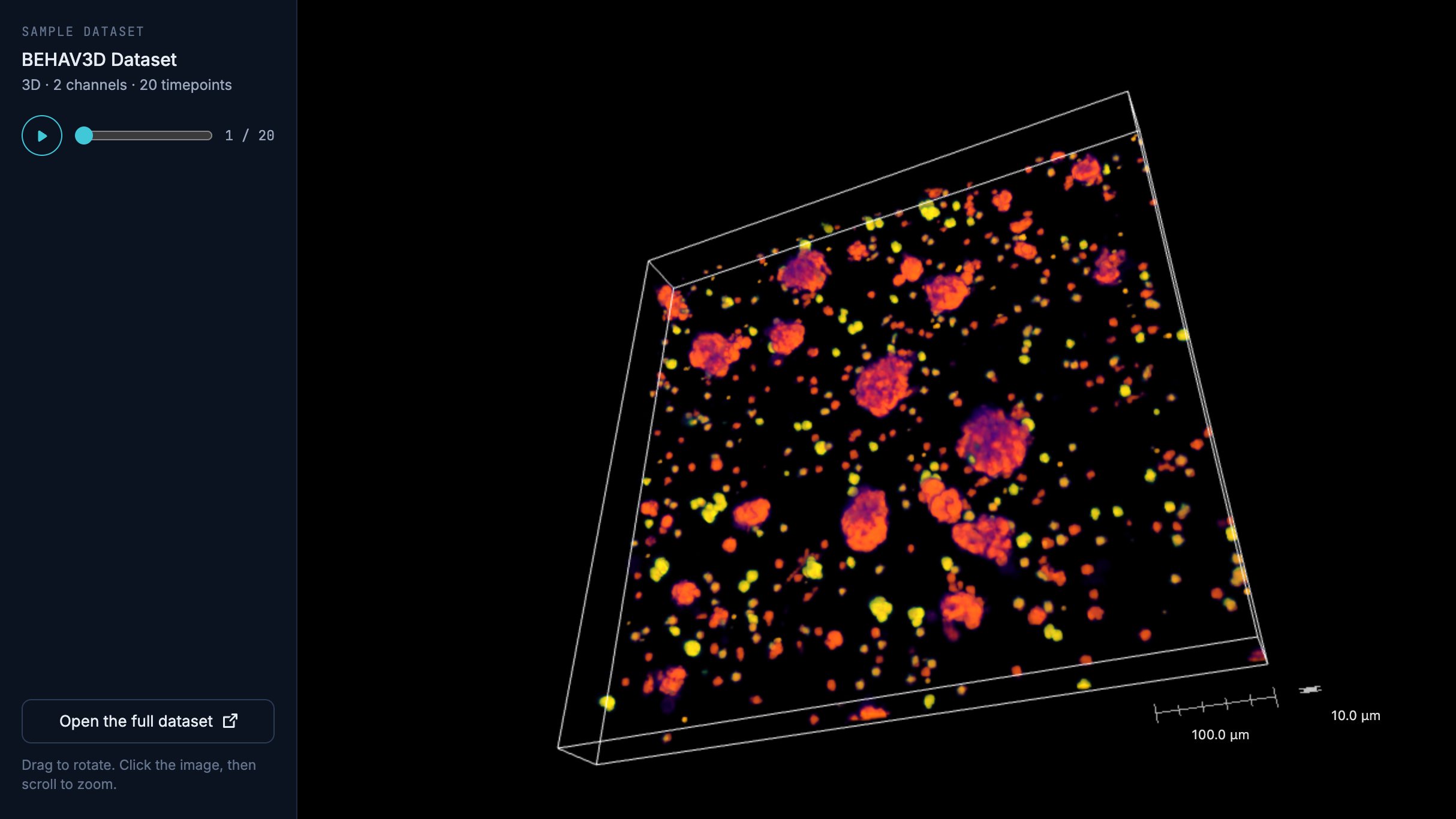
The CellWorkflow viewer on a BEHAV3D co-culture of T cells and organoids, rendered in 3D in the browser.
Your cells, stains and microscope are not what the open models were trained on, and the record is only as good as the cells it finds. Start from a current open model, correct it on a few of your own cells, and keep the result as your lab's model: versioned, shared with your team, and better with every experiment.
Run Cellpose-SAM, microSAM or StarDist on your images as they are.
Fix merged, missed and split cells in the viewer, in 2D or 3D. It shows you the cells it is least sure about first, so every correction counts.
Training runs on GPUs we manage, with nothing to install.
It is versioned and shared with your team, ready for the next experiment. Every result records the version that produced it and the annotations that trained it.
Why a few corrections go a long way: in the Cellpose 2.0 study, 500 to 1,000 annotated cells brought a pretrained model close to one trained on 200,000, and a human in the loop cut that to 100 to 200. Pachitariu and Stringer, Nature Methods, 2022
We package and test new releases as they come out, so they reach your lab without an install.
Cellpose with the Segment Anything image encoder, trained to generalize across cell images.
Pachitariu, Rariden and Stringer · Janelia Research Campus · 2025
Segment Anything adapted to light and electron microscopy. Click a cell for a mask, or segment a whole volume.
Archit, Freckmann, Nair and colleagues · University of Göttingen · Nature Methods 2025
Star-convex shapes for round, crowded objects such as nuclei.
Schmidt, Weigert, Broaddus and Myers · Max Planck Institute, Dresden · 2018
Follows cells across scales by picking, among many candidate segmentations, the one that tracks best.
Royer lab · Chan Zuckerberg Biohub San Francisco · Nature Methods 2025
A transformer that links cells from frame to frame, divisions included.
Bayesian tracking that follows cells through divisions into lineage trees.
Ulicna, Vallardi, Charras and Lowe · University College London · 2021
Paint a few strokes on your own images, in 2D or 3D, and train a classifier for structures no open model knows.
Label a few dozen tracks, say engaging or scanning, and every cell in every experiment gets a label, checked on held-out replicates.
Built into CellWorkflow
Already trained a model in your lab? Bring its weights and run it like any other, on the same GPUs.
From your lab
Type the question you would ask a postdoc. The agent works out what to check first, calls CellWorkflow for each step, reads the result, and decides what to do next. It cannot make a number up, because every number it gets back comes from an operation you can rerun yourself.
measures, runs the tests, keeps the record.
plans, reasons, writes it up.
Claude, ChatGPT and Codex, your company's agents, or a model running on your own hardware.
The operations are exposed through the Model Context Protocol, so any assistant that speaks it can use them, and the platform gets better as the models do. The session above runs on a simulated experiment we built to show the flow; the numbers are not from a real study.
When the agent tells you that engaging T cells spend more time on the organoid after treatment, you should not have to take its word for it. Click the number and you get the test, the eight replicate values behind it, the 547 tracks, and the frames those tracks were measured in. Rerun the operation and you get the same result, because the versions are recorded with it.
Phenotype C1, Engaging, shows increased contact with the organoid after Treatment A: , , over in , with behind it.
All of this is measured per cell and per frame. Together it is the phenome of the experiment: stored with its design, and available to you in the interface and to agents through the same operations.
Cells, nuclei and structures in 2D and 3D. Current open models out of the box, click-to-segment for the awkward cases, fine-tuning on your own annotations.
Identity kept through division, death and crowded co-cultures, with a lineage tree and a quality score for every track.
Volume, surface, shape and texture per object, and marker intensity per channel and per frame.
Neighbors, distance to structures, niches, and whether two cell types are found together more often than chance would put them.
Speed, displacement, persistence, state changes, and how the population shifts over the time-lapse.
Behavior groups with the measurements that define them and example cells for each, so you can rename or merge them when they do not match the biology.
Contacts and encounters between cell types or with structures such as organoids, how long they lasted, and what happened afterward.
Comparisons across conditions with one value per replicate, effect sizes, confidence intervals and confounder checks.
Plots and tables that know which cells they came from, ready for a paper, a lab meeting or an agent's report.
The experiments differ. The question mostly does not: what did the cells do, did the treatment change it, and would it hold up in review.
Contact time, encounters and killing per phenotype, compared across cell products and doses. This is the experiment CellWorkflow grew out of, with the BEHAV3D authors.
Lineage, migration and shape over days of imaging, with identity kept through divisions and without correcting tracks by hand.
Movement, shape and interaction phenotypes over time, per condition and dose, compared at the replicate level.
"The bottleneck was never the imaging. It was running the analysis: weeks of manual work per experiment, stitched across desktop software, notebooks and scripts. A platform that keeps the whole chain connected turns that into part of the experimental loop, not a quarterly project."
CellWorkflow exists because the original BEHAV3D authors wanted the pipeline they pioneered to be usable by every imaging lab, not just the ones that can dedicate a senior analyst to it for two to four weeks per dataset.


Group leader at the Princess Máxima Center for Pediatric Oncology, senior author of the BEHAV3D platform papers, and pioneer of 3D large-scale single-cell imaging of patient-derived organoids and immune co-cultures. Closely involved in shaping the platform's behavioral readouts.
Co-first author of Uncovering the mode of action of engineered T cells in patient cancer organoids (Nature Biotechnology, 2023), the study that introduced BEHAV3D, and first author of the BEHAV3D protocol (Nature Protocols, 2024). Established the behavioral phenotyping framework CellWorkflow productionizes.
CellWorkflow is a pre-seed venture. The platform was developed at the imAIgene Lab and is now being built into a product together with the labs that use it, so the groups who come in early still shape what ships next.
CellWorkflow is built in collaboration with, but is independent from, the Princess Máxima Center. Scientific advisors shape the analytical design of the platform and do not endorse its commercial claims.
Once a lab has a few experiments phenotyped this way, the interesting questions stop being about one dataset. We want a lab to be able to ask across everything it has imaged: whether a phenotype has shown up before, which earlier experiments responded the same way, and whether an effect is consistent between them.
Upload a dataset from something you imaged recently, any format, any size. We run it end to end and go through the first analysis with you on a 30-minute call, with a scientist rather than a sales rep.